The Pitfalls of Process
Processes are what make ERP run at all, and key to success. But there are limits.
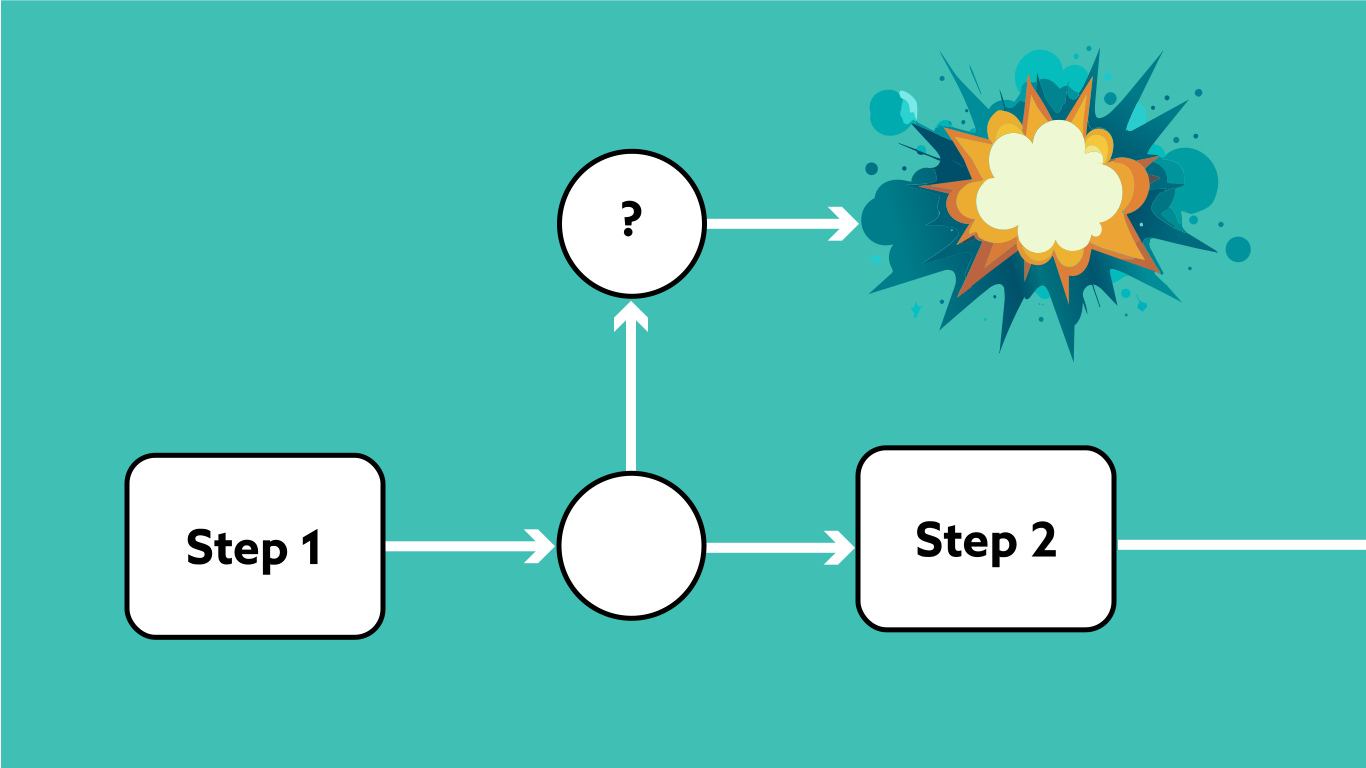
An ERP without processes can't work. And that includes Epicor Kinetic.
When implementing Kinetic, or any ERP, far more of the success or failure is down to how well you adapt and define your business processes than any other factor.
Why?
An ERP is many things in a business, but all of them rely on predictability and auditable data. That means defined business logic, defined flows, and knowing that it will be the same every time as well as that it can be inspected to mine what happened. For it to be able to do that, the real-world things that it models, records and controls, need to be defined, too.
They also need to be mapped cleanly and reliably to the built-in logic of the ERP itself. This is why implementation specialists tend to strongly recommend changing the company's processes to become more similar to the standard pattern of the ERP, as they can then guarantee a match and reliable functioning.
So, processes are good, then?
Processes are good, definitely. More than that, they're essential, which isn't quite the same thing.
But to anyone involved in ERP, this isn't news. What is less often mentioned is the limitations of process, and they're important. Slightly more abstract, and under-appreciated, but important.
Here's some things to consider.
The human factor
Computers and humans are good at different things. Computers are reliable. They will do exactly what they've been set up to do. If they're not doing the right thing, that's because you've set them up wrong. Humans are variable, flexible and intelligent. If they can see that pushing a button is going to cause a disaster, they won't do it. But they can also have off days when they make mistakes.
Managers and people running organisations like machines for that reason. And when you have powerful machinery and capable software, it's tempting to elevate it above the fallible humans. Get the software to control what the people do, and aim at making the humans as predictable as the machines.
The first disadvantage of this is that it's unnatural for those humans, strips them of a sense of meaning in what they do, and leads to dissatisfaction as a result.
If that's not a worry, you lose the edge that the combination of machine predictability and human judgement can bring. Too tightly defined, and the human becomes constrained by the limits of what the machine can do, while not being able to match its reliability. In attempting to eliminate mistakes, you actually remove local discretion and flexible decision-making.
Whatever you do, workarounds will develop. Either edge cases will be forced into standard patterns that don't suit them, or things will start to happen in ways that aren't approved, outside the systems you think you have. And all the time, it's pointless to have skilled and capable staff because they don't have any way to utilise the value they could bring.
In a chaotic world, predictability can be risky
Processes are designed around, and suit, the foreseeable. Every possibility needs to be allowed for.
In practical reality, it's not even possible to imagine every possibility. And if it was possible, in the case of ERP it would lead to such complexity that it would be a functional and maintenance nightmare. So in the real world, we build around a relatively fixed array of known eventualities, and we organise the framework we work within so as to limit what can happen. We assume a certain stability.
There are times, for all sorts of reasons, when everything becomes far less stable than we'd like. Sometimes we can ride that out, and sometimes chaos rolls in whatever we do. External factors beyond our control.
At those times, the more a system has been optimised for the expected stability, the more brittle it will be in the changes. The highly structured, efficient, foolproof processes, that are 100% reliable in the expected circumstances, begin failing and can't adapt. Competitors with looser systems that couldn't compete, may suddenly win everywhere because they are unconstrained by comparison.
So what's the answer?
Agility is the answer. Along with human judgement.
When designing your system, trust your users more than some ideal architecture, and where there's a choice leave them flexibility and don't box them in.
If something really cannot vary or fail, then that is a prime target for automation, and it should be removed from human contact altogether if possible. Let the humans have scope to do the things that humans can bring value to, and don't tie them down doing things where mistakes can't be tolerated.
Standardise where standardisation brings most value, and consider how far it needs to go.
However confident you may be that something will never change, think twice, three times, as many times as needed, before fixing it in stone. Consider what might happen if it did change, even if you think it can't, and have a fallback plan.
Watch for when process, or workflow, or your ERP, becomes a constraint, and face it early. When it becomes a reason why change is too hard or too expensive, it becomes a risk.
This is all difficult, because we always want to make success a pattern. We do what works, and we learn what works, and we try to repeat what works. And if it keeps working then we insist on it. Because success follows. And if we've had a hand in identifying what made that success happen then we're invested in it, too. And that stops us noticing when the world has changed and it's become a liability, often until it's too late.
Any time there's doubt, there will usually be humans who have a clear view, humans who can see the change.
Why draw attention to this?
As someone who makes a living from Epicor Kinetic ERP, I rely on organisations tailoring their systems, so in some ways I'm writing against my own interests here. Optimising is what I do.
But I do often have to push back, because over-optimisation is in nobody's interests long-term. I have seen often enough, by now, how confident assertion that something will never change ... turns into technical debt, rigidity in the face of market change, and makes other necessary future change into massively expensive risk.
Good ERP set-up should make it easier to change as the world changes, not lock you in place, and I hope I always advise accordingly.